The Man Who Decoded Market Rhythm
Ralph Nelson Elliott (1871-1948) was a professional accountant who, after a serious illness forced him into retirement, dedicated himself to studying stock market behavior.
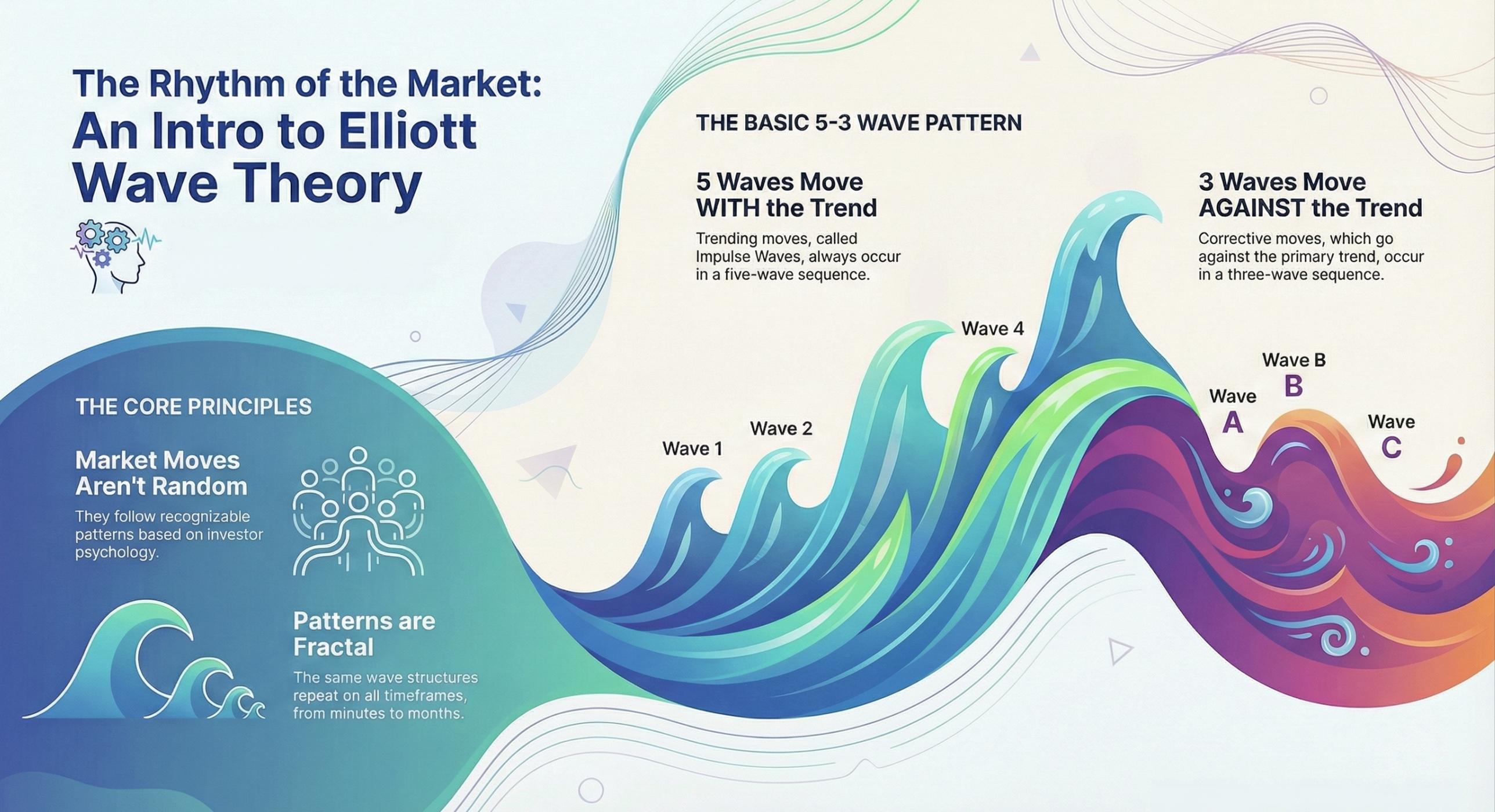
After analyzing 75 years of market data, Elliott made a groundbreaking discovery: markets don't move randomly - they follow recognizable, repetitive patterns that reflect the collective psychology of investors.
The Discovery
Ralph Nelson Elliott, a retired accountant, studied 75 years of market data and discovered that stock prices move in predictable, repetitive patterns he called 'waves'.
The Wave Principle
Elliott published 'The Wave Principle,' introducing his theory that market movements reflect the collective psychology of investors in fractal patterns.
Nature's Law
Elliott's final work 'Nature's Law – The Secret of the Universe' connected wave patterns to the Fibonacci sequence found throughout nature.
Why Paul Tudor Jones Relies on Elliott Wave
Paul Tudor Jones, the billionaire hedge fund manager who famously predicted the 1987 crash, has consistently cited Elliott Wave Theory as a core component of his market analysis.
"I attribute a lot of my own success to the Elliott Wave approach."
Jones used Elliott Wave analysis to predict the 1987 Black Monday crash, shorting the market and reportedly tripling his money while others lost fortunes.
His Tudor Investment Corp has managed billions using technical analysis frameworks including Elliott Wave.
Elliott Wave Mastery PDF Guide
Get our comprehensive slide deck that breaks down Elliott Wave Theory into actionable trading knowledge. Perfect for beginners and intermediate traders.
Download Your Free Guide
Enter your email below to unlock instant access
Frequently Asked Questions
What is Elliott Wave Theory?
Elliott Wave Theory is a form of technical analysis developed by Ralph Nelson Elliott in the 1930s. It identifies recurring wave patterns in financial markets, suggesting that markets move in predictable cycles of 5 impulse waves followed by 3 corrective waves, reflecting the collective psychology of market participants.
Why do legendary traders use Elliott Wave?
Hedge fund legends like Paul Tudor Jones rely on Elliott Wave because it provides a structural framework for understanding market psychology. It helps identify where we are in the market cycle, set price targets using Fibonacci ratios, and anticipate major turning points before they happen.
Is Elliott Wave difficult to learn?
The basic concept (5 waves up, 3 waves down) is simple. Mastering wave counting takes practice, but once you understand the 3 cardinal rules and common patterns, you'll see the market structure more clearly. Our PDF guide breaks it down step-by-step.
What timeframe works best for Elliott Wave?
Elliott Wave patterns appear on all timeframes due to their fractal nature - the same patterns repeat whether you're looking at 5-minute or monthly charts. Higher timeframes (daily, weekly) produce cleaner wave counts and are recommended for beginners.