
Leonardo of Pisa: The Man Behind the Numbers
Leonardo Bonacci (c. 1170-1250), known posthumously as Fibonacci ("son of Bonacci"), was an Italian mathematician who revolutionized European mathematics.
While studying under Arab scholars in North Africa, he learned the Hindu-Arabic numeral system (0-9) - far superior to Roman numerals. His 1202 masterwork "Liber Abaci" introduced these numbers to Europe and included a problem about rabbit reproduction that revealed the famous sequence.
"How many pairs of rabbits can be produced in a year from a single pair, if each pair produces a new pair every month...?"
- The original Fibonacci problem
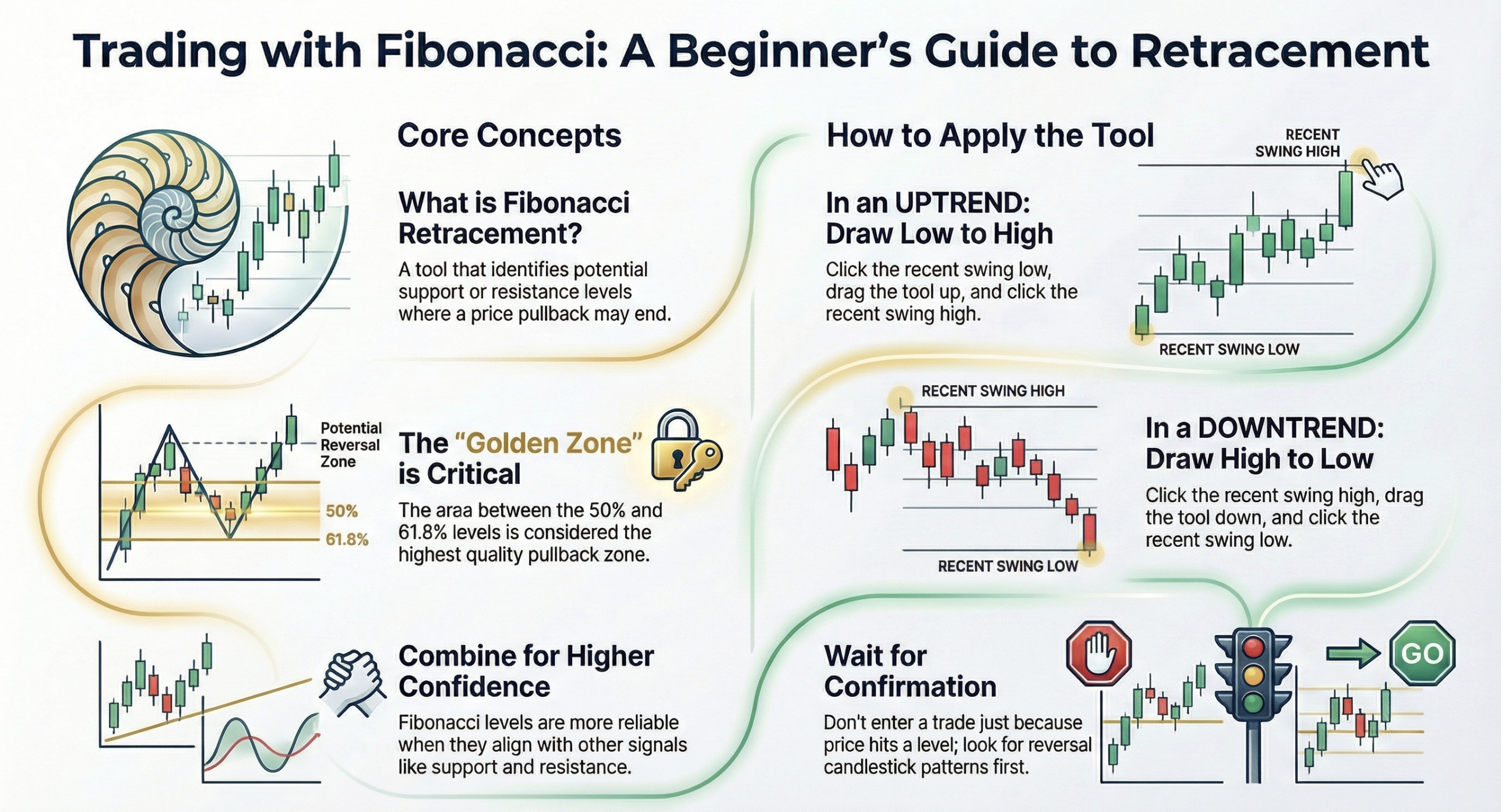
The Golden Ratio in Nature & Markets
The ratio between consecutive Fibonacci numbers converges to approximately 1.618 - known as Phi (φ), the Golden Ratio. This proportion appears everywhere in nature and, remarkably, in financial markets.
Nautilus Shell
The spiral follows the golden ratio
Sunflower Seeds
Arranged in Fibonacci spirals (55, 89)
Hurricane Patterns
Storm spirals follow φ proportions
Galaxy Arms
Spiral galaxies exhibit golden spirals
Human Body
Proportions from navel to head/floor
Financial Markets
Price retracements cluster at fib levels
From Medieval Mathematics to Modern Trading
1202
Liber Abaci Published
Leonardo of Pisa (later known as Fibonacci) publishes 'Liber Abaci' - introducing the Hindu-Arabic numeral system to Europe and presenting the famous rabbit problem that leads to the sequence.
1800s
Golden Ratio Discoveries
Mathematicians discover that the ratio between consecutive Fibonacci numbers approaches 1.618... (the Golden Ratio or Phi φ), found throughout nature, art, and architecture.
1930s
Market Application Begins
R.N. Elliott connects the Golden Ratio to market movements, observing that price retracements and extensions often align with Fibonacci percentages.
Today
Essential Trading Tool
Fibonacci retracements are now standard in every professional trading platform, used by millions of traders worldwide to identify key support, resistance, and profit targets.
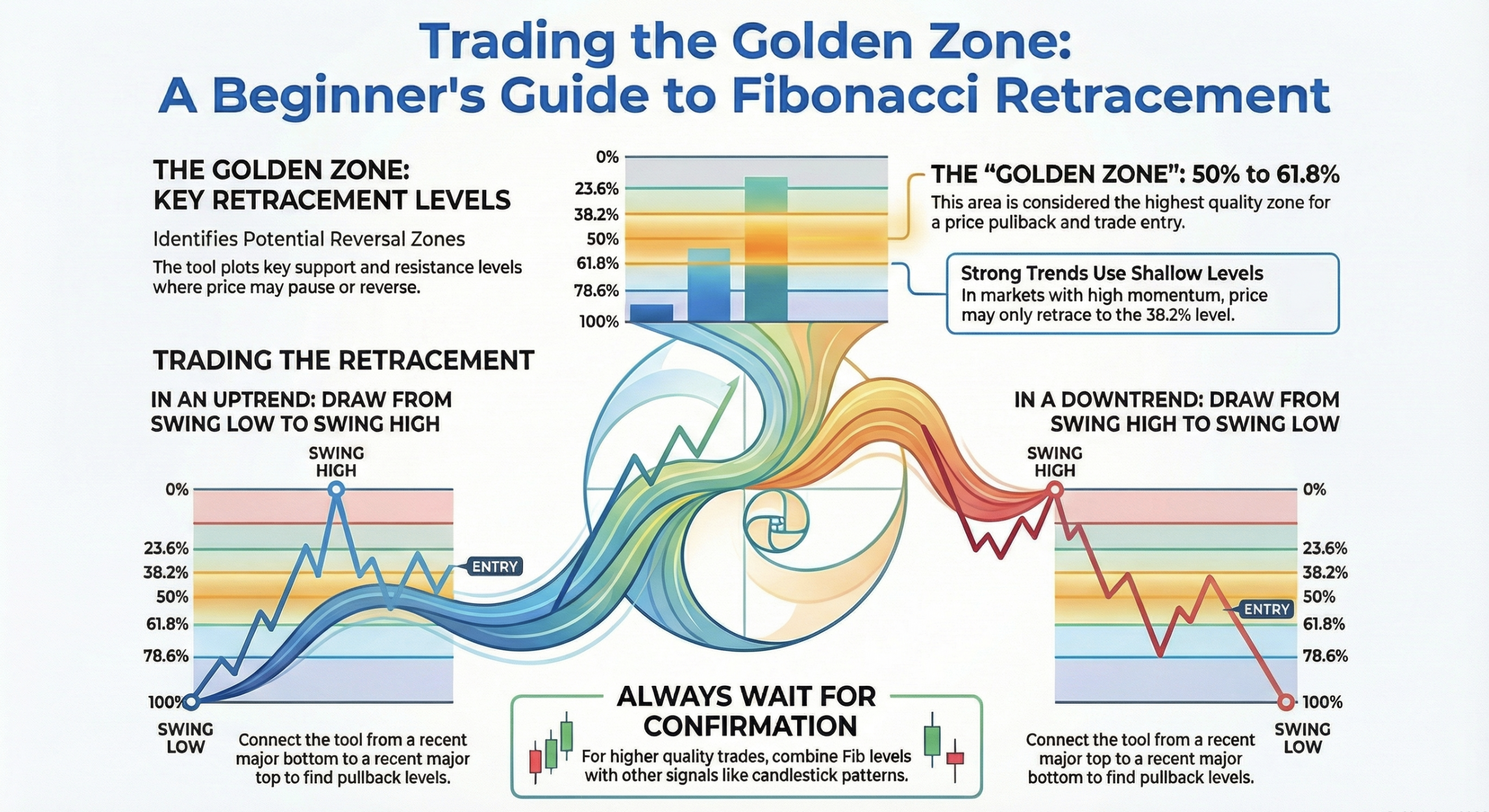
Why the 50%-61.8% Zone Matters
Professional traders call the area between 50% and 61.8% retracement the "Golden Zone" - the highest-probability entry area for trend continuation trades.
Fibonacci: The Hidden Code of Markets PDF
Get our comprehensive guide that transforms Fibonacci theory into actionable trading strategies. Perfect for traders ready to add precision to their entries and exits.
Download Your Free Guide
Enter your email below to unlock instant access
Frequently Asked Questions
Who was Fibonacci?
Leonardo of Pisa (c. 1170-1250), later nicknamed 'Fibonacci,' was an Italian mathematician considered the most talented Western mathematician of the Middle Ages. He introduced the Hindu-Arabic numeral system to Europe through his book Liber Abaci in 1202, which included the famous sequence that now bears his name.
What is the Fibonacci sequence?
The Fibonacci sequence is a series of numbers where each number is the sum of the two preceding ones: 0, 1, 1, 2, 3, 5, 8, 13, 21, 34, 55, 89, 144... The ratio between consecutive numbers approaches 1.618 (the Golden Ratio), which appears throughout nature and has applications in trading.
Why do Fibonacci levels work in trading?
Fibonacci levels work because they represent natural proportions that reflect human psychology and crowd behavior. When millions of traders watch the same levels, they become self-fulfilling. The 61.8% retracement (the 'Golden Zone') is particularly powerful because it represents a balanced pullback where trend continuation is most likely.
What are the most important Fibonacci levels for trading?
The key retracement levels are 23.6%, 38.2%, 50%, 61.8%, and 78.6%. For extensions (profit targets), traders focus on 127.2%, 161.8%, 200%, and 261.8%. The 'Golden Zone' between 50% and 61.8% is considered the highest-probability entry area.